I spent a weekend in a Buddhist temple in China. Am I a Buddhist? No. Do I speak any Chinese? Absolutely not. Yet it still worked out, and it was one of the coolest experiences I’ve had in my time in Asia.
I like seeking out a bit of discomfort, and a place where I can’t speak, can’t read and don’t share the religion seemed like a good place to find it.
It all started in the extremely touristy national park around Danxia mountain. I had chosen the ideal weekend: Labour Day. That meant EVERY CHINESE CITIZEN was on vacation, and it felt like at least half of them wanted to visit the exact mountain I was visiting. There were some side quests here as well, like walking into the forest behind my hostel, stumbling onto a paved path that turned out to be inside the park (sorry about the entrance fee), and ending up on a one-way staircase where everyone else was coming down. But that is a different story, and maybe I’ll tell it here someday.
Okay, back to the original story: the Buddhist temple. After being blessed with millions of local tourists the day before, I couldn’t wait. I had been planning this for a while now and was really excited.
The day started at 4:30AM, because I wanted to see the sunrise. It was so cloudy that there was no sunrise to see, so I went back to bed. (Remember the 4:30 part. It comes back.)
Then I packed my bags, got some cheap breakfast and started my trek to Shaoguan, the biggest city in the area: half an hour through the forest with all my luggage, past the spot where I had watched a snake hunting the day before, and then the bus.
In Shaoguan I waited an eternity for the only bus going to Nanhua Temple, today’s destination. All this time a Didi driver (Didi is basically China’s Uber) did his best to get me to pay him to take me there. But I was not going to give in, I was very committed to my bus. And even if I had wanted to give in, I did not understand a single thing he was saying to me.
After another 30 minutes of waiting, a woman, about 25, suddenly walked up to me and held a translation in front of my face: ‘Bus not coming until 2PM. I take Didi. Want to join?’
I guess I was taking a Didi after all. It was only 11AM, and the bus schedule, it turns out, is on WeChat and in Chinese. So I joined her and a father with his daughter in the car. They insisted I ride shotgun and did not want me to pay. But I insisted that I DID want to pay the 10 Yuan I owed them. I won that one. It was the last time that argument worked.
No monk, no guàdān
Once we arrived at the temple, I got a ticket and walked in, fully packed. With my North Face duffle on my back and my backpack on my front, it was not hard to attract the looks of EACH of the thousands of local tourists. And when I started asking monks about the kètáng (the guest office) to get guàdān, it did not get any better.
Guàdān is the word for lodging at a monastery. It comes from wandering monks hanging their robe and bowl under the monastery’s name list.[1] I had a duffle bag. I am not sure if the confused looks were because of how I butchered the words, or because I looked like I was about to set up a tent right in front of their eyes. The latter was not even that far from the truth…
After some time I found the guest office, and there I waited for monks to show up. In that time I made a new friend. I’ll call him Ming, which is not his real name, because I am about to tell the internet how he drives. He was a bit of an interesting character. He looked highly introverted, yet he clearly enjoyed talking to people. His English was barely better than my Chinese. Somehow we still managed to exchange names, and that was it for our first conversation.
I also met a Malaysian couple who spoke perfect English. Everyone wanted to know the same two things: how did I even know you can sleep in a temple, and was I a Buddhist? (The internet. And no, I just wanted to learn a bit about it.) Nobody minded. The Malaysians even went and talked to the monks for me.
They wanted to stay there themselves, and unlike me they actually had Buddhist passports. Yes, that is a thing. It made no difference. They tried to convince the monks, but the answer always stayed the same: No monk, no guàdān.
Damn. So I really came all this way just to get rejected? I honestly did not know what to do. Should I hide in the bushes and sleep outside? Should I start crying and hope they would let me stay? Should I give up?
Fortunately I did not have to do any of these things, because my new Malaysian friends came in clutch: they told me about another monastery, about one hour from Nanhua, where a friend of theirs had just stayed. I thanked them and was about to order a Didi, but not so fast. Ming had been listening, the Malaysians had translated the whole thing for him, and suddenly he offered to TAKE ME TO THE OTHER MONASTERY! He wanted to come along! This is a man who had come to Nanhua that day to volunteer.
For some reason, this was not at all weird in the moment. I was actually super excited to have company. And even though he was a bit weird himself, Ming seemed like an upright guy. So I agreed.
Vibes-based decisions
When we got to Ming’s car, the first thing I saw was a giant green stuffed animal seated in the passenger seat. Sick. After this being was removed, I settled into the Mini Roadster, 30 years old, with Ming next to me. We left, and then the real adventure began.
I think that after the first excitement we both quickly realized how stupid our decision had actually been. We had just met, barely knew each other’s names and had NO IDEA of the other person’s real intentions. Every decision so far had been literally vibes-based. At this point I think we both started evaluating whether the other one was maybe a serial killer. He constantly tried to call someone, and I nervously tried to make conversation with the help of the translator app.
Even though the situation was tense and awkward, I somehow felt happy. This was the discomfort I had come for. It is not often that you hit a Chinese highway in a Mini Roadster with a random guy you’ve just met. Actually, I am pretty convinced we are the first ones to have this experience.
The longer the drive took, the surer we both got that the other one’s intentions were sincere. Ming told me about his life: he does 3D animation at the ‘Chinese Pixar’ and actually worked on an animated dragon movie. Sick. His sister (the person he had been trying to call the whole time) is a doctor. Not exactly serial killer behaviour.
Eventually we arrived at the other monastery: Yunmen. Both relieved that nobody had been murdered, we went in. Note that we entered for free, because Ming actually has a Buddhist passport, and nobody questioned me following him like a dog. First we did a ritual where we burned three sticks of incense, and then we went straight to the guest office.
Of course nobody spoke any English, so I was fully in Ming’s hands. He talked to the monk, and all I saw in the beginning was the monk shaking his head. But Ming insisted. I thought monks never got angry, but this one did. Ming did not stop. This went on for about ten minutes, and the longer it continued, the less sure I was whether Ming was arguing my case or just harassing the monk.
Whatever it was, in the end I was granted access. Under the watchful eyes of an angry monk I wrote down my details, and we got sent off to our room. Ming was as happy as can be. He seemed very amused by his discussion with the monk, and especially by how it had turned out.
Fourteen
So here I was, ready to finally suffer in a monastery. The room had three beds for the two of us, a private bathroom, and it was genuinely beautiful. Price: zero euros. Was this the suffering I came for? Absolutely not. But hey, you take what you get.
On a walk around the grounds, Ming told me through Google Translate how sad it makes him that so many tourists come to these places just to take photos. After Danxia the day before, I could absolutely relate. Imagine the holiest place you know, and now imagine it on Labour Day weekend.
At dinner people kept talking to me in Chinese, and I answered with my entire vocabulary: either ‘I don’t speak Chinese’ or ‘I’m from Austria’. Both ended the conversation immediately.
At eight, Ming took me to a lecture by the high monk, in Chinese. I did not understand a single word and almost fell asleep. But everyone around me was hanging on his every word, so I am sure it was very good.
Before bed I met Elsa and Jason, a Chinese couple. Elsa spoke really good English, so I told them who I am and why I was here. It then came out that they had both assumed I was 14 years old.
FOURTEEN. I was 21. But whatever.
Everyone here is Eminem
4:30AM again. This time there was no going back to bed.
I went outside in my slippers to meet Jason and Elsa. Jason came out and started typing on his phone for a very long time, slowly moving closer to me. I figured he was translating something. He was. The message: no slippers, you need closed shoes. So I ran back and changed.
Inside the hall, men stood on one side and women on the other (also news to me), and at exactly 5:00 it began.
At first it was more of a spoken chant, everyone reciting together in a language that, as I found out afterwards, was not even Mandarin but something very old from India.[2] The guy on the drum set the speed, on what looked like a big shell and sounded like wood. And he kept getting faster. And faster. By the end, the monk standing directly behind me was really struggling to keep up. I was honestly impressed he had even gotten that far. I would not have stood a chance. I am sure even Eminem could learn a thing or two from these guys.
Then everybody filed out in a line. I thought that was it, so I went and got my bag. That was not it. So I got back in at the very end of the line. And who was walking right behind me? The high monk. We did a full circle around the temple grounds, bowing to the statues along the way, with him getting a perfect view of how little I knew what I was doing.
Then back into the hall for round two, this time real singing. I don’t think many people get to stand in a room like that, and after everything it had taken to get in, it felt very special.
At breakfast I came back to the table and found that Elsa and Jason had put some of their soybeans on my plate, because I needed my protein. Very cute. Nobody spoke otherwise, since a sign on the table asks you to be quiet and to eat everything, so that is what we did.
Afterwards I found a quiet little cove and meditated in the rain. I still had no idea how I was going to get to my train that day. But that was a problem for later.
The English version
I explored more of the monastery, and it was BEAUTIFUL. Then Ming, Elsa, Jason and I went on a hike to a waterfall.
On the way there I finally got the English version of everything I had not understood so far. Elsa and I talked about Buddhism for a long time, and the part I really liked was this: there is no god. I had bowed to a lot of statues that morning, so this was news to me. Buddha, as she explained it, is more of a role model, someone to live up to. Nobody up there knows everything and decides your fate. It is on you to improve yourself, which is what all the meditation is for.
Good karma in Buddhism, heaven in Christianity, Jannah in Islam. Very roughly, with a god or without one, it comes down to the same thing: be a good person and it comes back to you. And I had just spent a whole weekend being rescued by people who clearly were not keeping score. Maybe religion is not about who you believe in. Maybe it should just guide us to be good human beings.
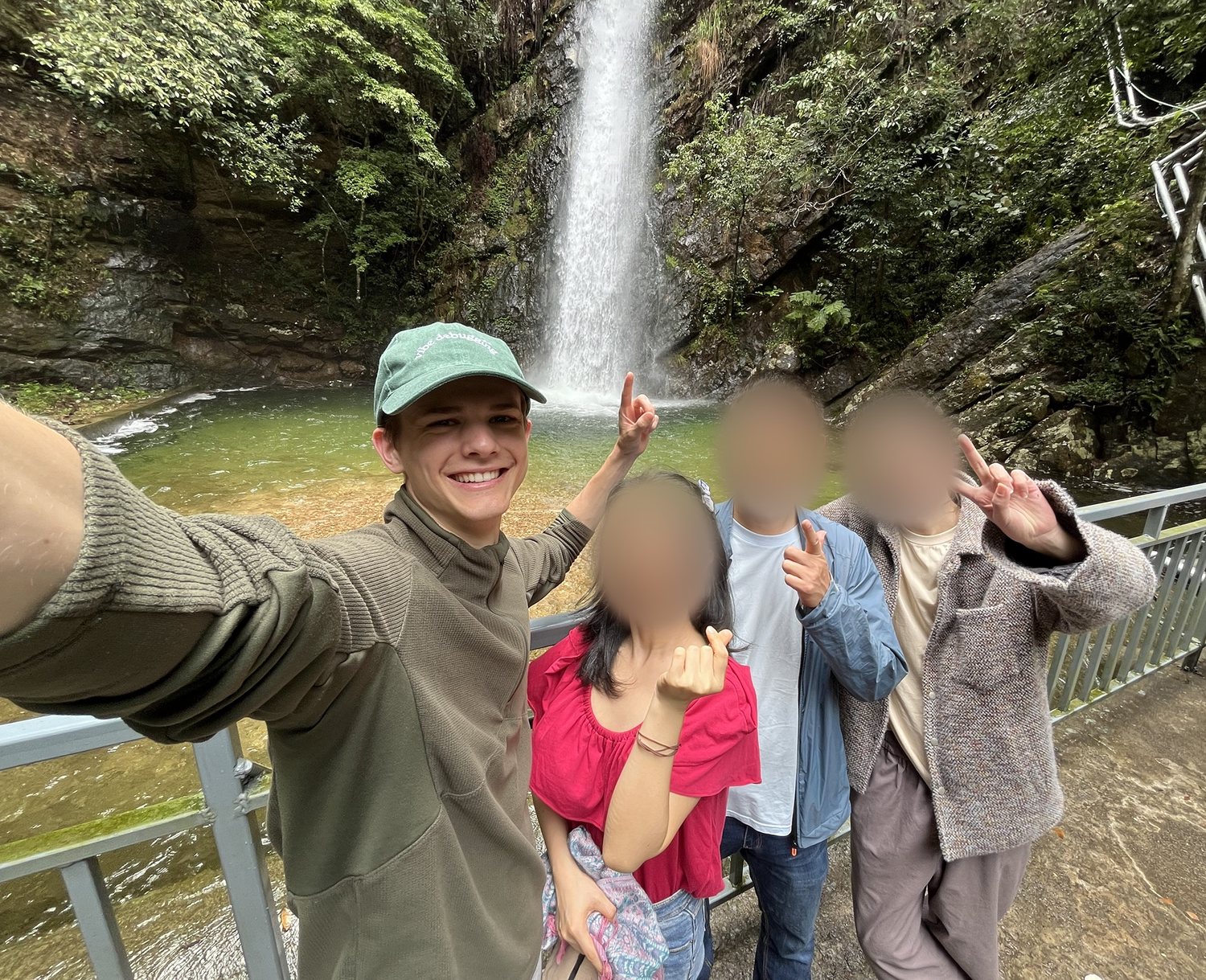
Okay, back to the original story: the waterfall. It was just as beautiful, and there we took a picture like a happy family. A day earlier these people had been complete strangers. Now we had Mom, Dad, the fun uncle who picks fights with monks, and their 14-year-old son.
The wrong station
Ming ended up driving me to the train station, and for once in this story I had no worries at all. I knew this guy now. Gentle, introverted Ming, the animator with the stuffed animal.
Then, somewhere along the way, he suddenly put on gloves.
Why was he putting on gloves? I found out immediately: he started driving like a race driver. In a Mini Roadster. Maybe his trust in me had grown and he wanted to show off? I don’t know. I was terrified. The day before I had been worried he might kill me on purpose. Now I was worried he might do it by accident.
We survived. It then took us a long time to find the station entrance. There was just one problem: it was the wrong station. After all that searching, I could not bring myself to say anything.
I tried to give him some money for all the inconvenience I had caused. He refused. Of course he refused. This man had driven me an hour out of his way and made a monk angry on my behalf, and he would not take a single Yuan. And he would not leave until he had seen me enter the station.
So I said goodbye to my friend, walked into the wrong train station with all my luggage, found another way out and got a taxi to the right one. Yes, I snuck out of a train station so a nice man wouldn’t feel bad.
The right station
Did I miss my train after all that? No. It was already there when I arrived, and I had 15 minutes to spare. Sorry, I would have liked a better cliffhanger too.
Now, something I haven’t told you: on the way here, I had taken first class without knowing it. It was incredibly luxurious. I even got breakfast and Wi-Fi. The train back was the exact opposite. It was the cheapest train ever, with SIX people in a cabin that was meant for two.
When I got to my seat, a guy started talking to me in Chinese. As you know, this is not my strength. I did not understand a word, I thought I had done something wrong, and everything was super confusing until we finally understood each other: he wanted to change seats. So I gave him my seat.
It was a very uncomfortable train ride. I loved it. Being squeezed in with everyone else felt way more real than breakfast and Wi-Fi. Was this the suffering I came for? Finally, yes. Sick.
So I did get my discomfort. I got rejected, I got into a stranger’s car, I got up at 4:30 twice and I feared for my life in a very small convertible. Mostly, though, people kept helping me for no reason at all. Ming most of all, and I never managed to pay him back.
Ming, if you ever run this through your translator and recognize the stuffed animal: thank you for everything. Also, it was the wrong station.
掛單. Chinese Wikipedia. Cited for the meaning of the term: monastics lodging at a monastery, named after a wandering monk hanging his robe and bowl under the name list in the monks’ hall. ↩︎
That is what I found out afterwards, and I can’t check it, since I did not understand a word. It may have been the Śūraṅgama Mantra, which Wikipedia describes as the first mantra recited at the daily morning service in most Chinese Buddhist temples. ↩︎